
Fig 01 / Case Study
AAI Financial Group
The Authorization Method in Action
An account of the Authorization Method conducted end to end for a single firm, from signing to proof: what was hypothesized, what was found, what was built, and what it produced—recorded against a standard set in writing before any money was spent.

$146
cost per booked call, against a $500 standard set in advance
$394m
committed pipeline generated on
$28K of ad spend, in 30 days
$1.68m
average deal size, matching the firm's own historical average
AAI Financial Group is a commercial lending advisory firm in Yakima, Washington. Since 2017 it has closed more than $526 million in transactions across more than 367 clients, at a close rate above 90% once a borrower's financials are in hand. Its founder, Matt Russell, is a former credit-union CFO. Its head of credit spent twenty-five years in banking and built an analytical operation—a forty-seven-tab underwriting workbook, custom risk models calibrated to individual lenders, a thirty-page credit memo that some banks use as their own internal pre-flight document—that most brokerage firms cannot approach.
None of that was visible to anyone who had not already worked with them.
This is the problem the Authorization Method exists to solve, and AAI is its clearest illustration. A business of genuine depth had grown for years on reputation and referral, where a trusted introduction did the work of explaining what the firm was worth. It had never advertised. Cold, the depth was invisible: everything that made AAI remarkable sat beneath the surface, and the market saw only another financial-services firm behind a wall of generic copy. The company's identity was its practice, and its practice was hidden.
The engagement ran in three phases—Authorization, Construction, Proof. It was signed on 2 April 2026. The machine went live on 29 June, three days ahead of a ninety-day schedule. Thirty days later it had cleared the standard the Strategic Blueprint set in April, and cleared the ceiling that Blueprint had treated as its optimistic case.
01/
Authorization
The work began before any conversation, with several hundred documents the firm provided—training transcripts, the underwriting templates, the intake checklists, the client agreements, a financial-education curriculum, years of closed-deal records.
From these a pre-extraction synthesis was assembled: a working hypothesis of what the business actually was, with every claim graded by the confidence the evidence supported. Facts drawn from the documents were marked as verified. Statements made in internal training, where there was no audience to impress, were weighted accordingly. Figures asserted in sales conversations were flagged as unconfirmed pending the firm's own data. The synthesis distinguished, on every line, between what was known and what was merely claimed.
The central hypothesis was called the Iceberg.
The contention was that AAI's value lived almost entirely below the waterline—in the analytical machinery no prospect ever saw—and that the firm's marketing problem was not one of persuasion but of revelation. The prospect did not need to understand the forty-seven-tab workbook. He needed to sense that behind an ordinary conversation stood an institutional-grade operation that would treat his $875,000 purchase with the rigor a bank reserves for a fifty-million-dollar development. Because it would.
The hypotheses were carried to Yakima for a two-day extraction: sixteen interviews across the firm, recorded and transcribed—Matt, the head of credit, the originators, the processor who runs every deal to closing, and clients. T
he purpose of the on-site was to test the document-built picture against the people who lived it, and to gather what documents could never supply: the specific language, the specific stories, the way the firm speaks when it is explaining rather than performing.
Most of the pre-extraction hypotheses held. Several sharpened. The most important finding was not a correction but a convergence. Working through the messaging in the room, Matt arrived, in his own words and under his own power, at the Iceberg thesis:
"I never thought, let's just hide it. They don't need to know what's going on behind the curtain. Probably need to know what's going on behind the curtain. So then our value actually goes up when they go, 'that's all the shit you handle?'"
The framework had been hypothesized from the outside, from documents, before arrival. The founder reached the identical conclusion from the inside, from twenty years of living it.
Two people arriving at the same essence from opposite directions is the strongest evidence available that the essence is real—that it was there to be found, not invented and imposed. This is the premise the entire Method rests on, demonstrated in a single room.
The extraction surfaced the spine of the identity in a sentence of Matt's: "I'm a CFO by trade. I take that same advice and look at my client." He is not a broker with financial credentials; he is a chief financial officer who happens to place loans.
Every instinct that defines the firm—talking a client out of a bad purchase, running a borrower's total cash position rather than a single property's, reaching out to a prospect's accountant directly to unblock a file—descends from that one fact. The advisory posture was not a marketing angle. It was the operating system of the business, and the extraction found it.
From the sixteen transcripts, cross-referenced against the pre-extraction picture, a post-extraction synthesis was built, and from that synthesis the two governing documents were declared.
The first was the Persuasion Genome: the essence of the firm, set down as its permanent commercial identity—its character, its mechanism, the pillars of its positioning, the buyers it is for and the ones it is not.
The second was the Strategic Blueprint, which takes that identity to market under present conditions. The Blueprint absorbed parallel analyses of the firm's search landscape and professional-network presence, mapped the competitive terrain, and set out precisely what would be built and how it would be measured. It also contained the standard of proof—a sensitivity matrix defining, in advance, what success would mean when the machine reached the market.
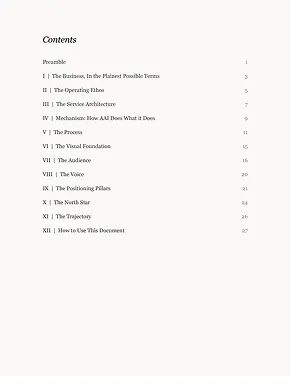
Exhibit A
The Persuasion Genome — table of contents. The twelve sections that set down the firm's permanent commercial identity, from its operating ethos to its positioning to its trajectory.
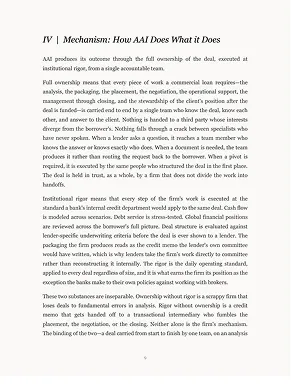
Exhibit B
From the Genome: the firm's mechanism, declared. Full ownership of the deal, executed at institutional rigor, from a single accountable team — the essence the extraction found in the founder's own words.
One reframe from the extraction shaped everything downstream. The firm believed its central objection was I can do this myself. The finding was that this was not an objection but an artifact of the firm's own reticence: by hiding the work, AAI had taught the market that the work was simple, which made a one-percent fee feel unjustified.
Show the market the field of risks a borrower cannot see—the appraisal that comes in low, the environmental report that stalls a closing, the credit committee that demands more equity at the eleventh hour—and the fee inverts, from an expense to be avoided into cheap insurance against a minefield.
The strategy that followed was built on two axes running together: the risks the prospect does not know exist, and the institutional depth that defuses each one. Fear made informed, then resolved by demonstrated capability.
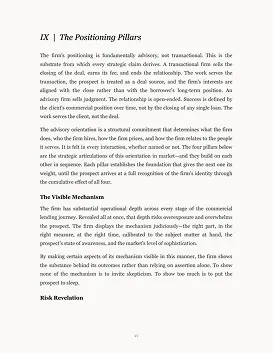
Exhibit c
From the Genome: the positioning pillars. The advisory posture and the naming of the risks a borrower cannot see — the strategy that would carry the firm's depth to a cold market.
That was the truth to be carried to market. The next phase built the thing that would carry it.
02/
Construction
Construction ran through May and June, on schedule, across three systems at once—the creative, the brand and web presence, and the operational infrastructure.
The identity, once declared, went to the designer, who met with Matt and the senior originator directly, absorbed the Genome, and rebuilt the firm's visual identity for a company that would now be seen cold rather than by referral.
In parallel, the operational core was replaced. AAI had been paying more than twenty thousand dollars a year for a Salesforce instance it used as a filing cabinet—no functional email, no text messaging, no capacity to build the pages a campaign requires, an interface forbidding enough that the team avoided it.
During the on-site it had become clear the platform could not support what the campaign would demand. The entire operation was migrated to a system purpose-fit for a nimble firm: the schema mapped, the migration paths determined, the historical records, pipeline stages, and deal history rebuilt to specification, with the automation the old system never had—document-collection sequences, follow-up, speed-to-lead notification—built in from the start.
the Brand
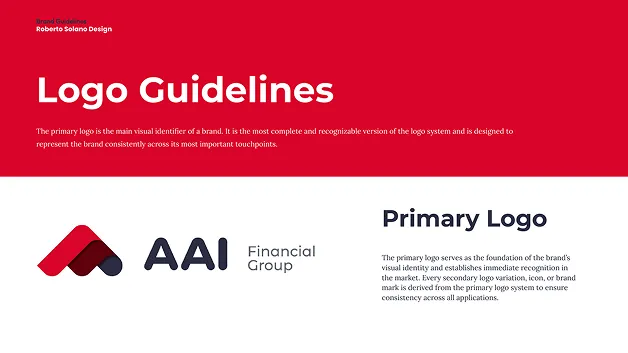
Exhibit D
The rebuilt identity: the primary logo. AAI had no formal brand system before the engagement; the modernized mark was drawn from the declared identity.
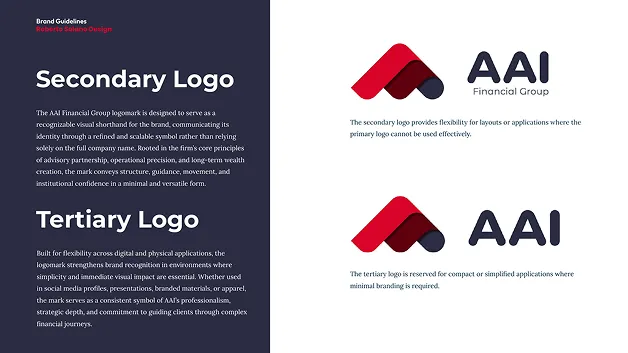
Exhibit E
The secondary and tertiary marks — the logo system built for every application, from full signature to compact.
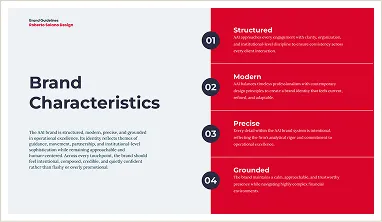
Exhibit f
The brand's declared character — structured, modern, precise, grounded — each attribute traceable to the Genome.
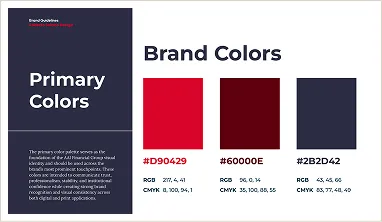
Exhibit g
The primary color system, formalized for the first time.
the website
The web presence was expanded beyond the engagement's original scope. Rather than the four-to-five-page microsite specified, a complete website was written and built, architected for scale and drawn from the market analysis—delivered as a value-add to a client whose engagement had already proven worth the enlargement.
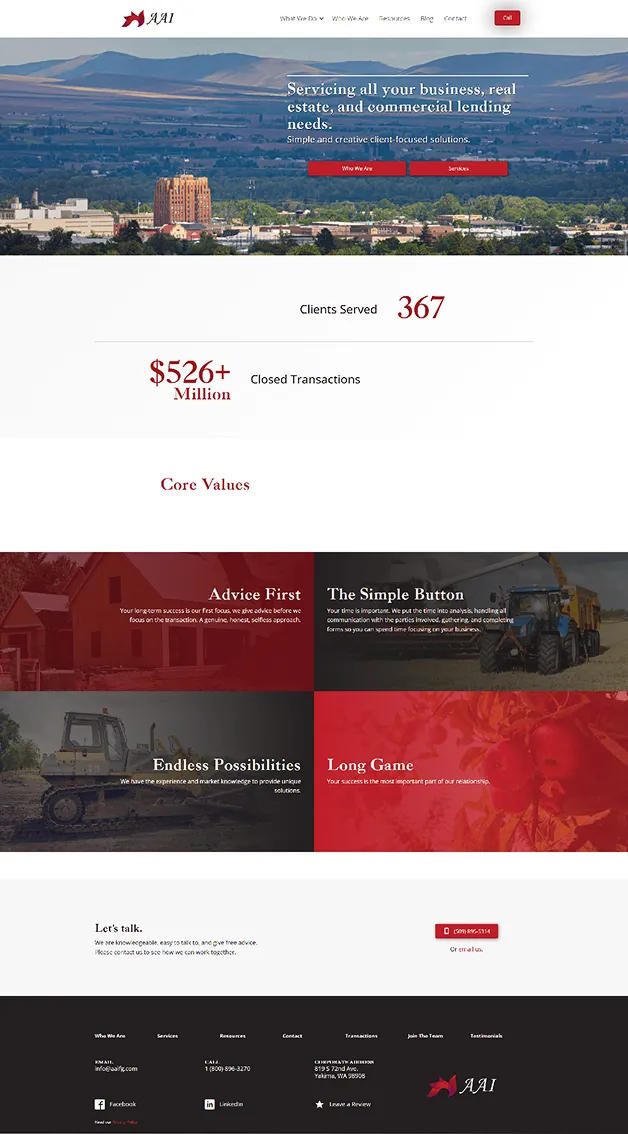
Exhibit h
The firm's original website. Generic financial-services copy over stock imagery — the wall the market saw, with none of the depth behind it visible.
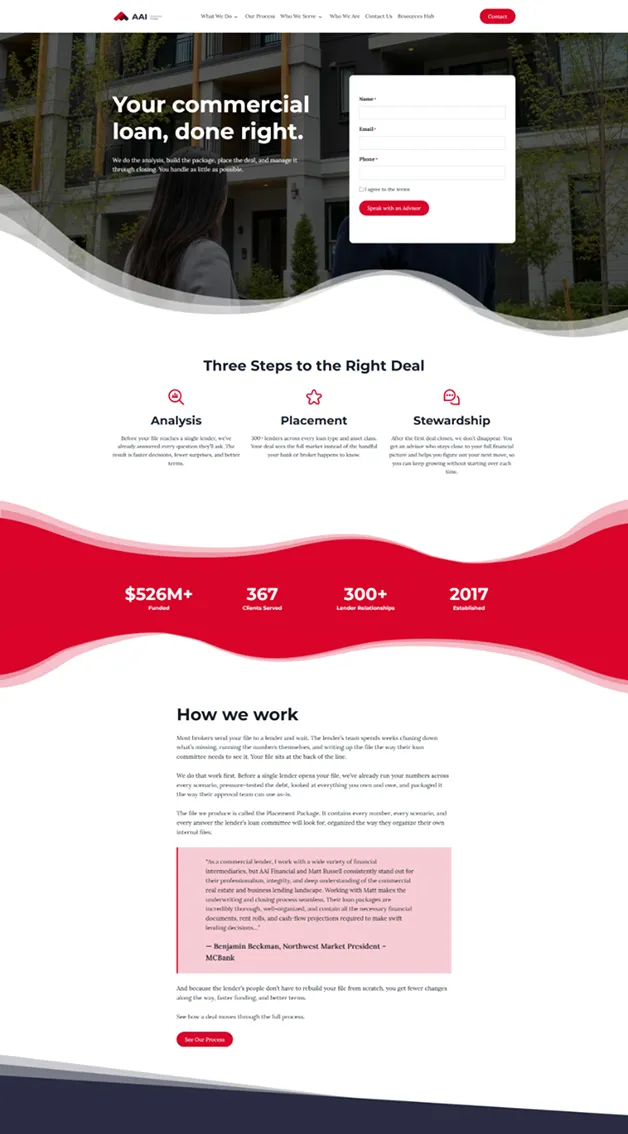
Exhibit i
The rebuilt site, architected for scale from the market analysis. The concierge mechanism, the buyer profiles, and the firm's real deal stories, made legible on the page.
the funnel
The final fortnight of June was a convergence. The migration completed; the marketing flows built—onboarding, intake, follow-up; the funnel pages assembled and the video loaded; the application, the scheduling, and the conversion tracking wired together through custom middleware.
The machine was assembled to the inventory the Blueprint specified, and it was ready three days early.
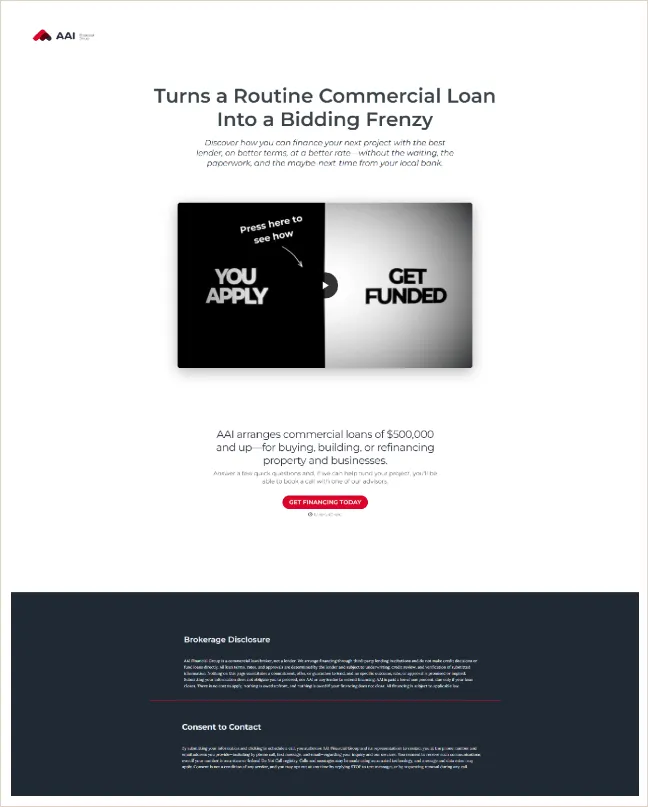
Exhibit j
The conversion funnel's application page — qualifying cold traffic at the door.
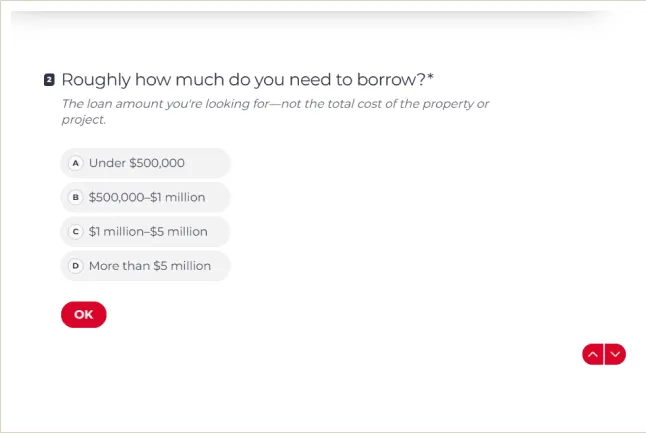
Exhibit k
The embedded application, native to the page.
Exhibit l
Native scheduling — the booking step built directly into the funnel.
the Creative
The creative was the translation itself, performed. Sixty scripts were written against the Blueprint's creative matrix, which works across three apertures: a wide lens addressed to anyone engaged in commercial activity, a middle lens addressed to the specific buyer profiles, and a narrow lens addressed to particular use cases—five treatments for each positioning pillar, so the full identity was represented across the full spectrum of the market.
In the second week of June the production was shot on-site in Yakima over two days: the full video sales letter, the sixty advertisements, and roughly a dozen due-diligence films answering the objections a borrower carries before he reaches a call.
Each advertisement was finished in two renderings—one for the feed, one for reels—bringing sixty scripts to a hundred and twenty finished units.
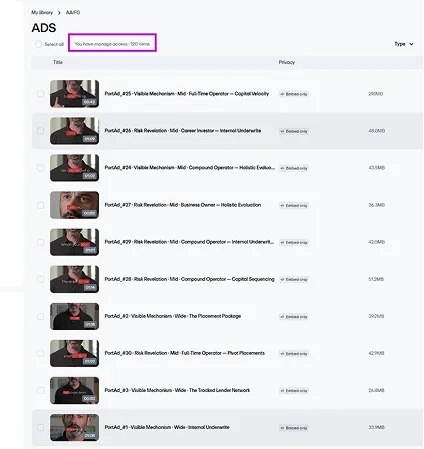
Exhibit o
The finished creative library — sixty scripts rendered in two formats each, a hundred and twenty units, sufficient for multiple full testing cycles.
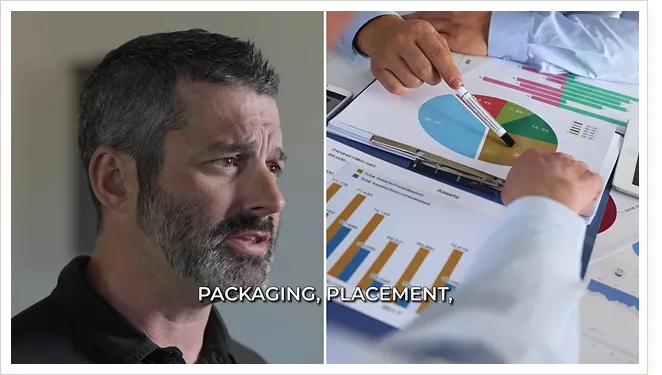
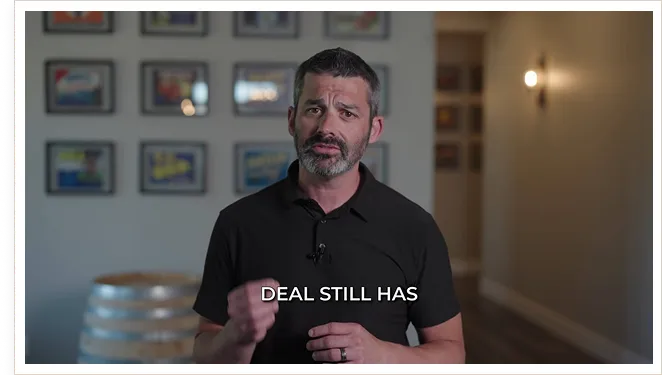
Exhibit m
Frames from the video sales letter, shot on-site in Yakima. The founder on camera, scripted for teleprompter delivery — the translated identity, performed.
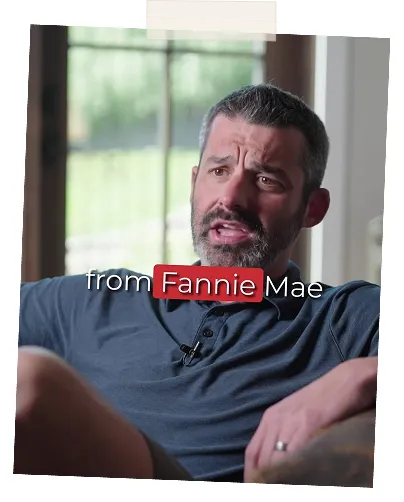
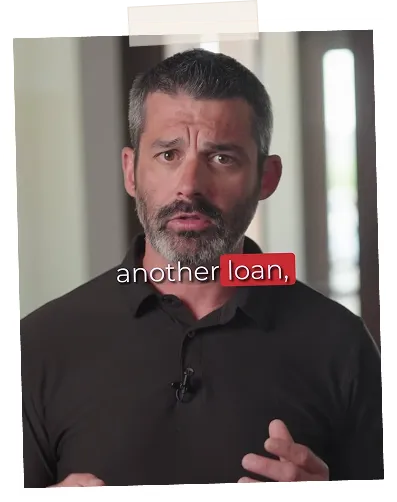
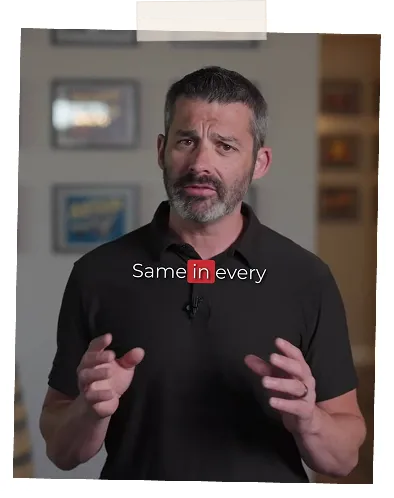
Exhibit n
Three of the sixty advertisements, one from each aperture of the creative matrix — the narrow concierge concept, the mid-lens risk-revelation message, the wide wealth-creation frame. Different facets of one declared identity, each shot in a different setting.
Exhibit o
The finished creative library — sixty scripts rendered in two formats each, a hundred and twenty units, sufficient for multiple full testing cycles.
Systems & Intelligence
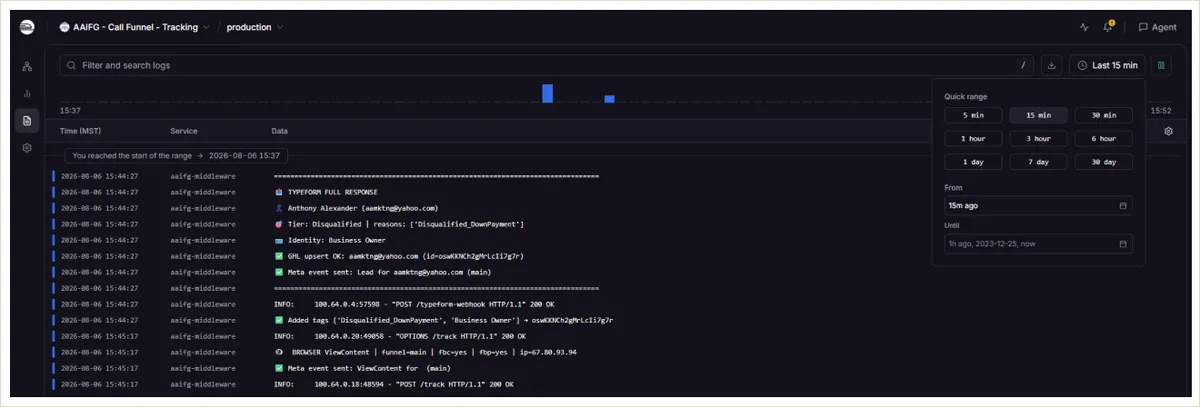
Exhibit p
The custom-built attribution layer, tracking conversions in real time — the infrastructure that let performance be measured against the standard from the first day.
Exhibit q
A sample of the operational automation — pipeline-value calculation, committed-pipeline tracking back to the platform, and buyer-profile-specific due-diligence sequences — built into the new operating core.
What happened at launch belongs to this account because it became the engagement's clearest proof, and it was not planned.
AAI had never advertised. The account was new, the tracking new, the domain unknown to the platform. New accounts in sensitive categories are fragile, and finance is as sensitive as they come. So the account was warmed for roughly a week before any direct-response creative ran—innocuous engagement content stacking approvals and on-time payments, then awareness content drawn from the founders' own podcast, building the platform's trust in the account and its daily spend capacity.
By launch the account carried more than a hundred approvals, more than a hundred settled payments, and thousands of engagements. It was in good standing.
The direct-response campaign went live on 29 June. It booked calls on the first day. On the second day, the platform's automated systems classified the domain under Special Ad Categories—the regulated designation applied to credit, housing, and employment advertising. Continuing to run outside that designation, once the platform had assigned it, risked the account entirely.
The campaign was stopped and relaunched inside the Special Ad Category, declared, so that no question of circumvention could arise.
The declaration carried a consequence. Special Ad Categories strip an advertiser of targeting. The plan had never relied on targeting to find the right borrower—the creative was always the instrument meant to do that work—but the Blueprint had set a few modest parameters at the outset.
It excluded the five largest metropolitan markets, out of deference to a belief inside the firm that the primary markets, spoiled for options, would not be interested; the analysis recorded that this belief was not shared, only accommodated to get the campaign underway.
And because the firm's client base is historically male and entirely over thirty, the plan excluded the segments that would only have spent budget inefficiently. These were efficiencies applied around a strategy that already rested on the creative. Under the regulated designation none of them is permitted: delivery must be fully broad, all genders, eighteen and older, no geographic restriction. The parameters came off.
What remained was the creative, doing exactly the work it had always been built to do, now under conditions broader than the plan had ever intended. The message, and nothing else, would decide who the machine reached. That was never a gamble on the firm's part. It was the premise of the whole engagement, put to a more demanding test than anyone had designed—and the results that followed were produced under it.
What happened at launch belongs to this account because it became the engagement's clearest proof, and it was not planned.
AAI had never advertised. The account was new, the tracking new, the domain unknown to the platform. New accounts in sensitive categories are fragile, and finance is as sensitive as they come. So the account was warmed for roughly a week before any direct-response creative ran—innocuous engagement content stacking approvals and on-time payments, then awareness content drawn from the founders' own podcast, building the platform's trust in the account and its daily spend capacity. By launch the account carried more than a hundred approvals, more than a hundred settled payments, and thousands of engagements. It was in good standing.
The direct-response campaign went live on 29 June. It booked calls on the first day. On the second day, the platform's automated systems classified the domain under Special Ad Categories—the regulated designation applied to credit, housing, and employment advertising. Continuing to run outside that designation, once the platform had assigned it, risked the account entirely. The campaign was stopped and relaunched inside the Special Ad Category, declared, so that no question of circumvention could arise.
The declaration carried a consequence. Special Ad Categories strip an advertiser of targeting. The plan had never relied on targeting to find the right borrower—the creative was always the instrument meant to do that work—but the Blueprint had set a few modest parameters at the outset. It excluded the five largest metropolitan markets, out of deference to a belief inside the firm that the primary markets, spoiled for options, would not be interested; the analysis recorded that this belief was not shared, only accommodated to get the campaign underway. And because the firm's client base is historically male and entirely over thirty, the plan excluded the segments that would only have spent budget inefficiently. These were efficiencies applied around a strategy that already rested on the creative. Under the regulated designation none of them is permitted: delivery must be fully broad, all genders, eighteen and older, no geographic restriction. The parameters came off.
What remained was the creative, doing exactly the work it had always been built to do, now under conditions broader than the plan had ever intended. The message, and nothing else, would decide who the machine reached. That was never a gamble on the firm's part. It was the premise of the whole engagement, put to a more demanding test than anyone had designed—and the results that followed were produced under it.
03/
Proof
The Blueprint had defined proof, in April, as performance landing anywhere in a modeled sensitivity matrix at or above its conservative cell. That conservative cell assumed a cost per booked call of $500 against the firm's historical close rate, producing fourteen engaged clients, $245,000 in committed pipeline value, and a return of 8.2 times on advertising spend. The number was written down and signed before a dollar was spent.
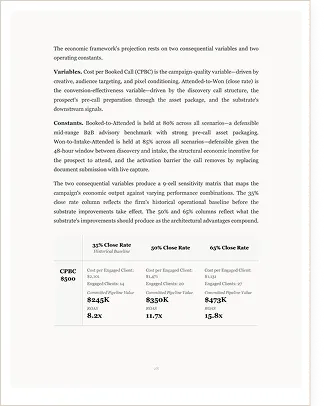
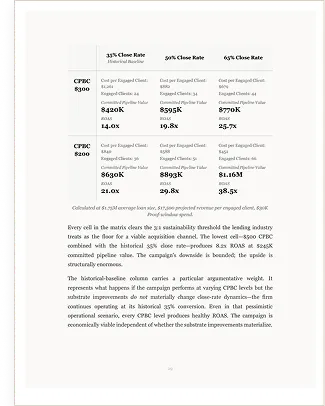
Exhibit r
The Proof Standard, as set in the Strategic Blueprint in April — a sensitivity matrix modeling the campaign's economics before a dollar was spent. The conservative floor: $500 cost per booked call, $245K committed pipeline, 8.2× return.
The campaign ran for thirty days, from 29 June to 28 July, on $28,067 of advertising spend, warming excluded.
Cost per booked call came in at $146.18—3.4 times better than the conservative standard, and 27% below the $200 that the matrix had treated as its strongest, most optimistic column.
The funnel moved 415 completed applications to 241 qualified prospects to 192 booked calls, and it converted efficiently enough that conversion would have to fall below 1.67% before cost per booked call even approached the $500 floor. The machine cleared the standard by a margin wide enough to absorb heavy dilution as spend scales.
Cost per booked call came in at $146.18—3.4 times better than the conservative standard, and 27% below the $200 that the matrix had treated as its strongest, most optimistic column. The funnel moved 415 completed applications to 241 qualified prospects to 192 booked calls, and it converted efficiently enough that conversion would have to fall below 1.67% before cost per booked call even approached the $500 floor. The machine cleared the standard by a margin wide enough to absorb heavy dilution as spend scales.
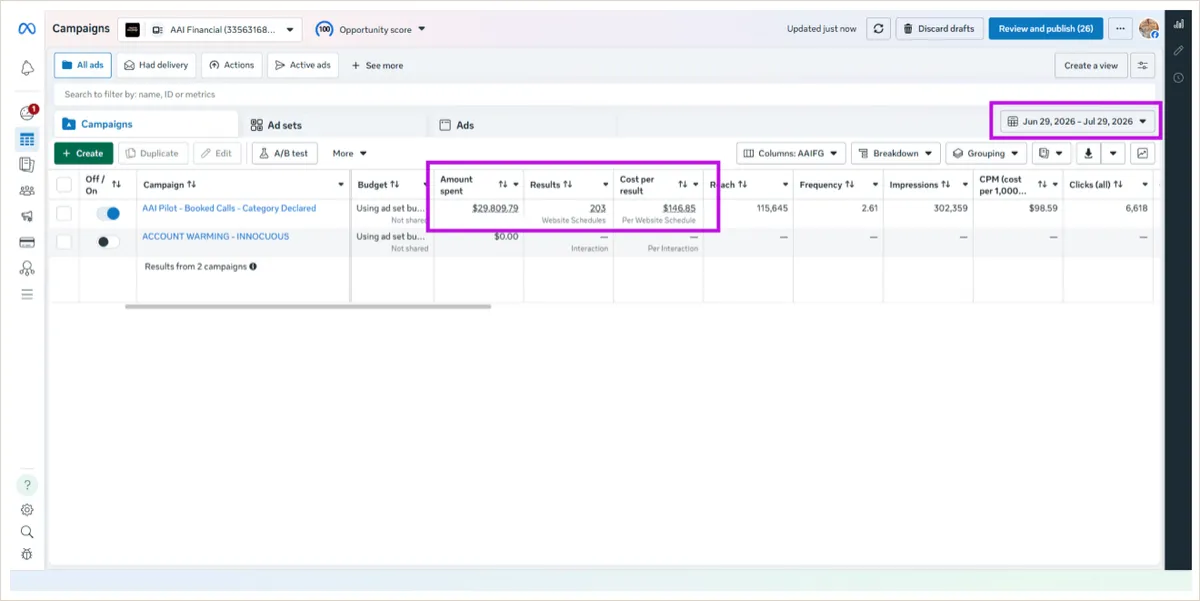
Exhibit q
The campaign at the close of the proof period. (Figures shown run slightly ahead of those cited in the text: the Proof Period Analysis used a midday cutoff, and the campaign booked additional calls later the same day.)
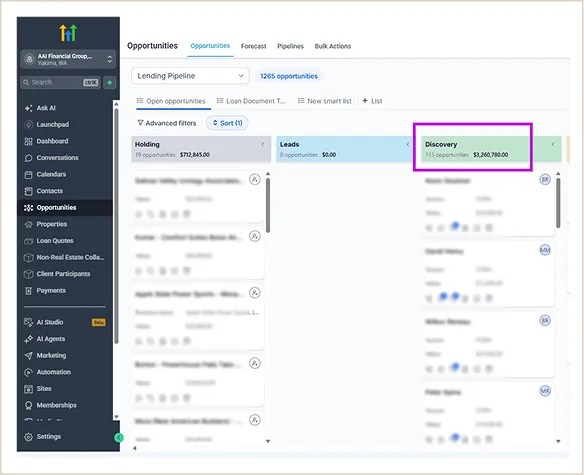
Exhibit t
The committed pipeline in the firm's live system — the Discovery stage, carrying 113 opportunities generated by the campaign against more than $3.2 million in projected commission. (Individual deal values obscured for client confidentiality.)
The pipeline is reported the way the analysis reported it: conservatively first, with its largest components set aside so the underlying figure stands on its own.
Sixty-two opportunities were recorded during the window. Two of them—a $115 million multifamily portfolio acquisition and a $70 million portfolio refinance—accounted for sixty percent of the total loan value, and both attended, advanced, and survived the review that cleared questionable leads from the pipeline.
Because two transactions of that scale distort any summary, they are reported separately.
Excluding those two deals, and combining the recorded opportunities with a conservative estimate of the second originator's unreported book—modeled at the first originator's observed rates, on identical prospects from identical ads, whose deals differed by under three percent in size—the campaign produced 111 committed opportunities carrying $209.2 million in estimated loan value. Including the two large transactions, the figure is $394.2 million.
These deals fund four to six months after first contact, as commercial loans do. The firm's own conservative judgment is that roughly a third of prospects reaching this stage eventually fund—an operator's estimate, which the analysis flags as the largest unverified input in the work.
Even in the most heavily discounted scenario available—both large deals excluded, and only a quarter of the remainder assumed to fund—the campaign returns $522,973 in collected commission against $28,067 in spend: 18.6 times. The conservative case, stripped of every favorable assumption, is already an extraordinary result. Every case above it is more so.
One figure settles the question of whether the creative did what the stripped targeting left it to do. The Blueprint's economics were modeled on the firm's historical average loan of roughly $1.75 million.
The campaign's modal deal came in at $1.68 million—within four percent of the firm's own long-run average. Under fully broad delivery, with every targeting parameter removed, the creative reached the same borrower the firm had built its practice on by referral. The message, drawn from the declared identity, was precise enough to be the targeting.
The campaign cleared the standard the Blueprint set, and cleared the ceiling the Blueprint had treated as its optimistic case—in the firm's first thirty days of ever having advertised.
A note on what mattered
Partway through the engagement, before the campaign had gone live and before any result existed to justify it, the firm's principals recorded an episode of their own podcast reflecting on the work. What they singled out was not the production or the media plan. It was the Authorization—the extraction of the raw material, and the Persuasion Genome that came out of it.
The founder described the shift in his own thinking. His instinct across a nine-year career had been to do the work and let it speak for itself, to keep the machinery behind the curtain and simply deliver.
The engagement reversed that.
As he put it, sometimes after years head-down in a business you need someone to clap you on the shoulder and show you what you're doing right—and that you're simply not telling anyone. The senior originator said much the same from the other side: even his own friends and family had never quite understood what he did, and the work of setting down the whys and the hows of the practice was what finally made it sayable.
That is the Method's whole claim, recognized by the people who paid for it—and recognized before the numbers arrived to prove it. The advertising performed because it had something true to carry, and the truth was established before the first dollar moved. What the market saw in thirty days was not persuasion applied to a business. It was a business, finally made legible to the people who were always going to want it.
P.S.
As of 27 September 2026 the account is still going strong. Cost per booked call has normalized at $125.50 against the $500 the Strategic Blueprint set as its proof floor, and the final week of the quarter closed at $103.14. Since the 29 June launch the campaign has produced 779 booked calls on $101,806 of advertising, carrying $591 million in estimated loan value and $5.9 million in expected commissions on the conservative basis—through two full waves of creative, a complete turnover of the account's lead advertisement, and the diagnosis and correction of a platform-level audience bias.